
Boiler Repair in West Medford, Medford, MA
West Medford is one of the city’s established neighborhood and square districts. This page focuses on practical boiler-service decisions for properties in the West Medford area rather than repeating a generic Medford landing page.
Common Boiler Problems We Can Help Route in West Medford, Medford
Choose the problem that best matches what you are seeing. The detailed service pages explain the diagnostic considerations without repeating the same guide on every neighborhood page.
Heating service around West Medford
West Medford has a distinct neighborhood center and is one of the districts the City highlights in its neighborhood and wayfinding work. For a heating request, the useful local detail is the property itself: whether the system serves a single residence, multiple units, or a mixed-use building, and how heat is distributed inside it.
A boiler problem may appear as a complete loss of heat, one cold zone, pressure that will not hold, water near the equipment, or a burner/control fault. Those symptoms do not identify the failed component by themselves, so the service request should start with what is actually happening rather than a preselected repair.
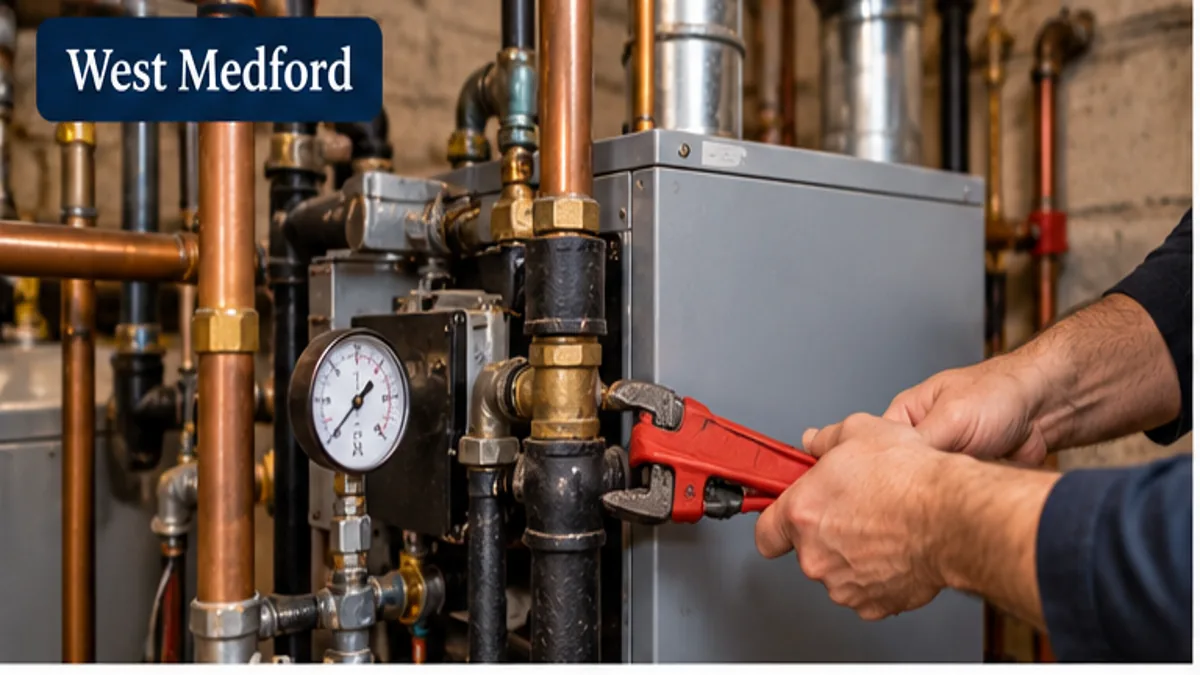
Reading an uneven-heat complaint before parts are replaced
A West Medford heating call is more useful when the symptom is described by location and timing. If the boiler fires but a rear bedroom, upper floor, or one radiator stays cool, the first question is not automatically “what is wrong with the boiler?” A hydronic system depends on thermostats, zone valves, circulators, piping, air removal and heat emitters working together. A steam system has a different set of distribution clues, including venting and condensate return behavior. Note which rooms are affected, whether the problem started suddenly, and whether other zones recover normally. That information helps a heating professional separate a central heat-source problem from a distribution problem and avoids replacing components simply because they are near the boiler.
Pressure loss, relief discharge and visible water need different descriptions
A pressure gauge that falls over hours is not the same symptom as a relief valve that releases water when the system heats. Likewise, a damp fitting, a corroded circulator flange and water beneath an expansion tank point to different inspection paths. Before requesting service, look only from a safe distance and record where water is visible, whether the boiler is hot or cold, and whether pressure changes as the system runs. Do not tighten hot fittings or cap a relief outlet. On a closed-loop hot-water system, repeated pressure loss can involve a leak, fill-valve issue, expansion problem or another fault that requires testing. Clear observations are more valuable than guessing which component should be replaced.
Radiators and baseboards can reveal a circulation problem
When some heat emitters warm quickly and others remain cool, distribution deserves attention. Baseboard sections can be affected by trapped air, restricted flow, a closed valve, a circulator issue or a zone-control problem. Cast-iron radiators can show different patterns depending on whether the system is hot water or steam. Homeowners can note whether the pipe entering the radiator becomes hot, whether unusual gurgling is present, and whether the thermostat is calling for heat. Those details help frame the diagnostic visit. Bleeding, draining or changing valves without knowing the system type can introduce new problems, so service decisions should follow identification of the actual heating configuration.
What a useful diagnostic visit should establish
A sound boiler diagnosis should establish the system type, the active symptom, relevant control calls and the condition of the components connected to that symptom. For a no-heat complaint, that can mean checking power, thermostat demand, safeties, ignition sequence and circulation. For pressure complaints, it can mean observing cold and operating pressure and checking the expansion and fill side of the system. For uneven heat, attention shifts toward zoning and distribution. The goal is not to run through an identical checklist for every property; it is to connect evidence to the complaint. Ask what was found, what test supports the diagnosis and whether the proposed work addresses the cause or only a visible consequence.
Planning maintenance around system condition
Maintenance is most useful when it is tied to the actual boiler and distribution system rather than sold as a generic annual package. A gas boiler, oil boiler and steam boiler have different service needs. Water quality, venting, burner condition, safety devices, pumps and controls may matter differently from one installation to another. If the system has a history of pressure loss, noisy circulation or recurring lockouts, include that history during maintenance because intermittent faults may not appear during a short operating cycle. Keeping previous invoices, model information and notes about recurring symptoms can also make future troubleshooting more efficient. Maintenance should support reliable operation; it should not be used to mask an unresolved repair issue.
When the safest next step is to stop operating the equipment
Some symptoms should move the conversation from comfort to safety. A fuel odor, suspected combustion-gas problem, active electrical burning smell, significant water near electrical components or a condition that appears unsafe should not be treated as a routine reset-and-watch situation. Follow manufacturer instructions where available, avoid dismantling equipment, and use emergency resources when there is an immediate hazard. For ordinary no-heat conditions without an apparent hazard, record the error code before resetting anything and avoid repeated resets. A repeated safety lockout is information: clearing it over and over can erase the pattern a technician needs to diagnose the underlying fault.
Start with heat distribution, not just the boiler
In a hydronic system, a boiler can fire while one part of the property remains cold. Thermostats, zone controls, circulators, valves, trapped air, and baseboard or radiator flow can all affect comfort. If only one floor or room group is affected, include that detail when requesting service.
If the entire property has no heat, note whether the boiler has power, whether an error code is visible, and whether there is an active leak. Do not open combustion components or bypass a safety control.
Useful symptoms to include
- No heat throughout the property
- One cold zone or uneven rooms
- Water near the boiler or piping
- Pressure repeatedly dropping
- Ignition or control error
- Radiator or baseboard not warming
Detailed boiler service pages
The location page establishes coverage. The service pages contain the deeper repair information, so we do not duplicate the same boiler guide under every neighborhood name.
Questions about boiler service in West Medford
What should I include in a West Medford boiler service request?
Provide the 02155 ZIP code, the main symptom, fuel type if known, any visible error code, whether water is leaking, and whether the whole property or only one zone has lost heat.
Can a cold room be a boiler problem?
Sometimes, but not always. Zone valves, circulators, thermostats, trapped air, radiator valves, and distribution piping can cause uneven heat even when the boiler is operating.
Should I reset a boiler repeatedly if it keeps shutting down?
No. Repeated lockouts can indicate a fault that needs diagnosis. Avoid repeatedly resetting equipment or bypassing safety controls.
Request boiler service in West Medford
Tell us the ZIP code, the heating symptom and the equipment type if known. The repair scope and contractor availability are confirmed after the request is reviewed.